An ancient Buddhist guide to confronting difficult circumstances and letting go of clinging to the ego.
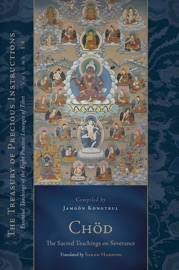
Severance, or Cho, is the Tibetan Buddhist practice of facing oneās fears. In three remarkable texts lucidly translated and introduced by Sarah Harding, the thirteenth-century Severance master Jamyang Gonpo shares advice that goes straight to the heart of both understanding and experiencing the practice. For hundreds of years, Severance has remained essentially an instruction on coping with stressful situations that provoke fear and, beyond that, a way to actively seek out such circumstances in order to test oneās realization of perfect wisdom.
The single overall directive of the first two texts in this volumeāthe Heart Essence of Profound Meaning root verses and their commentary, The Big General Guide to Severanceāis to seek out and directly confront difficult circumstances. Here, these difficulties are often anxieties related to spirits in the dark of night in haunted places. This practice acts as a means to recognize emptinessāthe lack of intrinsic existence of all phenomenaāas well as a testing ground of oneās former realizations and studies of that emptiness from the Perfection of Wisdom. The texts are notable for their lack of instruction on ritualized Severance involving body sacrifice, which later works emphasize; in these texts, the heart of Severance is letting go of clinging to the self and reification of existence. And as Jamyang Gonpo was just a generation removed from Machik Labdron, the main progenitor of Severance, his methods seem to be closest to her actual teachings.
The third translation in this volume, The Seven-Day Severance Retreat Experiential Guide, is a very concise and precise instruction on putting the main intentions of the teachings into practice in the setting of a one-week retreat. The instructions are striking in that they contain no rituals, visualizations, deities, instruments, or liturgies. Jamyang Gƶnpo shows us how to turn our attention to the very mind of this person who is experiencing fear and the object of that fearāwhether fear about demons or sickness or sufferingāto see them for what they are. In doing so, we find that joys and sorrows, highs and lows, powers of gods and demons, and demonic obstacles are all mind made.
Severance - Sarah Harding, Jamyang Gonpo & Lodro Tulku Rinpoche
By Sarah Harding, Jamyang Gonpo & Lodro Tulku Rinpoche
An ancient Buddhist guide to confronting difficult circumstances and letting go of clinging to the ego.
Severance, or Cho, is the Tibetan Buddhist practice of facing oneās fears. In three remarkable texts lucidly translated and introduced by Sarah Harding, the thirteenth-century Severance master Jamyang Gonpo shares advice that goes straight to the heart of both understanding and experiencing the practice. For hundreds of years, Severance has remained essentially an instruction on coping with stressful situations that provoke fear and, beyond that, a way to actively seek out such circumstances in order to test oneās realization of perfect wisdom.
The single overall directive of the first two texts in this volumeāthe Heart Essence of Profound Meaning root verses and their commentary, The Big General Guide to Severanceāis to seek out and directly confront difficult circumstances. Here, these difficulties are often anxieties related to spirits in the dark of night in haunted places. This practice acts as a means to recognize emptinessāthe lack of intrinsic existence of all phenomenaāas well as a testing ground of oneās former realizations and studies of that emptiness from the Perfection of Wisdom. The texts are notable for their lack of instruction on ritualized Severance involving body sacrifice, which later works emphasize; in these texts, the heart of Severance is letting go of clinging to the self and reification of existence. And as Jamyang Gonpo was just a generation removed from Machik Labdron, the main progenitor of Severance, his methods seem to be closest to her actual teachings.
The third translation in this volume, The Seven-Day Severance Retreat Experiential Guide, is a very concise and precise instruction on putting the main intentions of the teachings into practice in the setting of a one-week retreat. The instructions are striking in that they contain no rituals, visualizations, deities, instruments, or liturgies. Jamyang Gƶnpo shows us how to turn our attention to the very mind of this person who is experiencing fear and the object of that fearāwhether fear about demons or sickness or sufferingāto see them for what they are. In doing so, we find that joys and sorrows, highs and lows, powers of gods and demons, and demonic obstacles are all mind made.
More by Sarah Harding, Jamyang Gonpo & Lodro Tulku Rinpoche