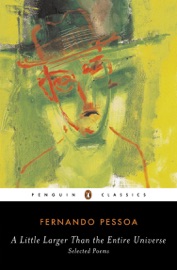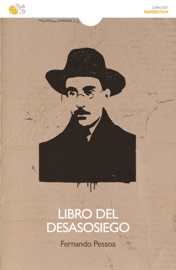
Fernando Pessoa is best known for his heteronyms, personas under which he wrote some of the most famous prose in Portuguese literature. Educated at an English-speaking school in Durban, South Africa, Pessoa developed a considerable command of English and continued to write privately in the language throughout his life.
Presented here are Pessoaâs early collections 35 Sonnets and English Poems, as well as two poems published individually in periodicals before 1929. All were written and published in English under Pessoaâs own name, and compared to Pessoaâs later work in Portuguese, none of them are especially well-regarded by critics.
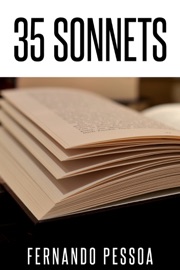
Pessoaâs aim in 35 Sonnets is to scale the same heights that Shakespeare did with the form, but his efforts have been received less as an approximation of the latterâs achievement than a pastiche of it. Among the strains and contortions characterizing Pessoaâs imitation of Elizabethan English, there are nevertheless flashes of linguistic and metrical felicity as he surveys themes of despair, unrequited love, the fraughtness of human connection, and the mystery of the universe.
The sonnets stand in sharp thematic contrast to the poems in Pessoaâs second collection, English Poems. The first of them, âAntinous,â imagines the Roman emperor Hadrianâs perspective on his relationship with the Greek youth Antinous. Detailing Hadrianâs devotion to Antinous after the latterâs death, it has been called by Pessoaâs most recent biographer Richard Zenith âthe most compelling love poem that Pessoa would ever write.â âEpithalamiumâ has been understood by critics as a response to Pessoaâs reading of Spenserâs ode âEpithalamion.â The sexual elements latent in Spenserâs poem are made aggressively explicit in Pessoaâs version.
In his letters, Pessoa singled out the two longer poems in English Poems as âclearly obscene,â and claimed that they were the only works of his to qualify as such. He explained to his first biographer that composing them was a way of eliminating the ideas they contained from his mind. Of biographical interest is that the poems that Pessoa himself regarded as obscene are among the only works whose publication he took the trouble to self-finance during his lifetime; further, he was content to publish them under his own name.
Despite failing to achieve critical acclaim, the poems in this compilation provide insight into Pessoaâs early literary concerns and establish that the beginning of his poetic career was marked by intense ambition and audacious self-assurance.
Fernando Pessoa is best known for his heteronyms, personas under which he wrote some of the most famous prose in Portuguese literature. Educated at an English-speaking school in Durban, South Africa, Pessoa developed a considerable command of English and continued to write privately in the language throughout his life.
Presented here are Pessoaâs early collections 35 Sonnets and English Poems, as well as two poems published individually in periodicals before 1929. All were written and published in English under Pessoaâs own name, and compared to Pessoaâs later work in Portuguese, none of them are especially well-regarded by critics.
Pessoaâs aim in 35 Sonnets is to scale the same heights that Shakespeare did with the form, but his efforts have been received less as an approximation of the latterâs achievement than a pastiche of it. Among the strains and contortions characterizing Pessoaâs imitation of Elizabethan English, there are nevertheless flashes of linguistic and metrical felicity as he surveys themes of despair, unrequited love, the fraughtness of human connection, and the mystery of the universe.
The sonnets stand in sharp thematic contrast to the poems in Pessoaâs second collection, English Poems. The first of them, âAntinous,â imagines the Roman emperor Hadrianâs perspective on his relationship with the Greek youth Antinous. Detailing Hadrianâs devotion to Antinous after the latterâs death, it has been called by Pessoaâs most recent biographer Richard Zenith âthe most compelling love poem that Pessoa would ever write.â âEpithalamiumâ has been understood by critics as a response to Pessoaâs reading of Spenserâs ode âEpithalamion.â The sexual elements latent in Spenserâs poem are made aggressively explicit in Pessoaâs version.
In his letters, Pessoa singled out the two longer poems in English Poems as âclearly obscene,â and claimed that they were the only works of his to qualify as such. He explained to his first biographer that composing them was a way of eliminating the ideas they contained from his mind. Of biographical interest is that the poems that Pessoa himself regarded as obscene are among the only works whose publication he took the trouble to self-finance during his lifetime; further, he was content to publish them under his own name.
Despite failing to achieve critical acclaim, the poems in this compilation provide insight into Pessoaâs early literary concerns and establish that the beginning of his poetic career was marked by intense ambition and audacious self-assurance.